
Basement renovations often look simpler on paper than they perform in real houses. Owners may see unused square footage and assume the main job is to finish it well. In Ottawa, the more important question is whether the basement can support the intended use without fighting moisture, access, ceiling depth, servicing constraints, and life-safety requirements from the beginning.
That is why basement planning has to start with realism rather than with finishes. A lower level can become highly useful, but not every basement can deliver the same rooms, the same ceiling quality, or the same degree of openness. When the early conversation skips those limits, the project usually absorbs the correction later through redesign, rework, or a compromised outcome that never fully matches the original expectation.
Below-grade work is also deceptive because some of the most important risks are hidden in assemblies that already exist. Moisture movement, older slab conditions, headroom limits under beams and ducts, small window openings, and irregular service routes do not announce themselves through decor. They become visible when feasibility, investigation, and coordination are taken seriously enough to test what the house can actually support.
At OakWood, that is why serious basement planning is treated as a technical exercise before it is treated as a finish package. The value of a disciplined design-build process is not that it promises every basement can become anything. It is that it helps define what is viable, what has to change, and what level of intervention is needed to reach a durable and credible result.
Below-grade conditions set the real starting point
A basement renovation begins inside an existing environment that behaves differently from the main floors of the home. Some lower levels stay consistently dry and temperate. Others show a history of dampness, air leakage, slab cold, older patchwork repairs, or wall assemblies that were never meant to support modern finished use. The visible surface may look serviceable, but the performance burden sits deeper than paint, flooring, or trim.
That is why the first serious question is not what the room should look like. It is what the lower level is already telling you about its limits. Evidence of past seepage, musty air, surface staining, uneven slab areas, perimeter cracking, low beam pockets, or crowded mechanical routes changes the renovation conversation immediately. Those issues do not automatically stop the project, but they do change the scope required to produce a responsible result.
In older Ottawa homes, basements also tend to carry years of piecemeal intervention. One area may have been insulated in a different era, another patched after a plumbing event, another reworked to accommodate new electrical or heating equipment. That history matters because basement planning is rarely dealing with one clean starting condition. It is often dealing with accumulated decisions that were made for utility, not for a finished living standard.
Moisture risk has to be solved in assemblies, not hidden behind finishes
Moisture is one of the clearest reasons basement projects disappoint. Owners can spend heavily on flooring, millwork, lighting, and paint, only to discover later that the real weakness was never resolved at the wall, slab, drainage, or air-sealing level. A basement that looks finished but still behaves like a damp lower level is not a successful renovation. It is a cosmetic upgrade built over an unresolved technical problem.
This is why moisture planning must be treated as an assembly question. The team has to think about where water can enter, where vapour can accumulate, how materials will dry, and which finish choices are compatible with below-grade conditions. In some homes, the answer involves modest corrective work and careful detailing. In others, it may require more serious intervention before the desired rooms can credibly move ahead.
Owners sometimes interpret this as unnecessary caution because the basement may feel mostly fine during parts of the year. The problem is that lower-level performance is seasonal and pressure-dependent. What appears acceptable in a dry period can behave very differently under snowmelt, spring rain, high summer humidity, or cold-weather condensation conditions. That is why a disciplined process tests durability before it commits to a finish strategy.
The practical takeaway is straightforward. If the moisture story is weak, the renovation story is weak. Durable basement outcomes come from resolving the cause, then selecting materials and detailing that respect the reality of below-grade construction. They do not come from assuming a cleaner finish palette will somehow create performance that the underlying assembly does not support.
Egress and access determine what rooms can be called and how safely they function
Basement planning is also shaped by how people enter, move through, and exit the level. Owners often begin with a room list – bedroom, office, gym, rec room, bathroom, suite, or guest space – but the viability of those uses depends heavily on egress and access. A basement can feel spacious and still fail to support a specific intended use if the opening sizes, exit path, stair geometry, or related life-safety conditions do not align with that use.
This matters most when the plan includes sleeping rooms or a stronger degree of independent occupancy. Window size, well conditions, path to exit, and the relationship between rooms are not finishing details. They influence layout, wall placement, and whether the proposed arrangement is credible at all. When these requirements are treated as late-stage checks, they often force exactly the kind of redesign owners thought they were avoiding by moving quickly.
Stairs also deserve more respect than they usually receive in basement conversations. The stair determines how the lower level connects to the rest of the house, how comfortably furniture and materials can move, how natural the circulation feels, and how much usable area is lost at the point of entry. In tighter homes, the stair landing and adjacent clearances can drive a surprising amount of the final plan.
The same principle applies to secondary suites or more separated basement uses. The project is no longer just about making the level attractive. It becomes about whether the lower level can function as intended within the real requirements that govern safety, access, and room configuration. A professional process surfaces that early so the design does not drift into names and uses the space cannot honestly support.
Ceiling height is usually shaped by structure and services before design taste enters the room
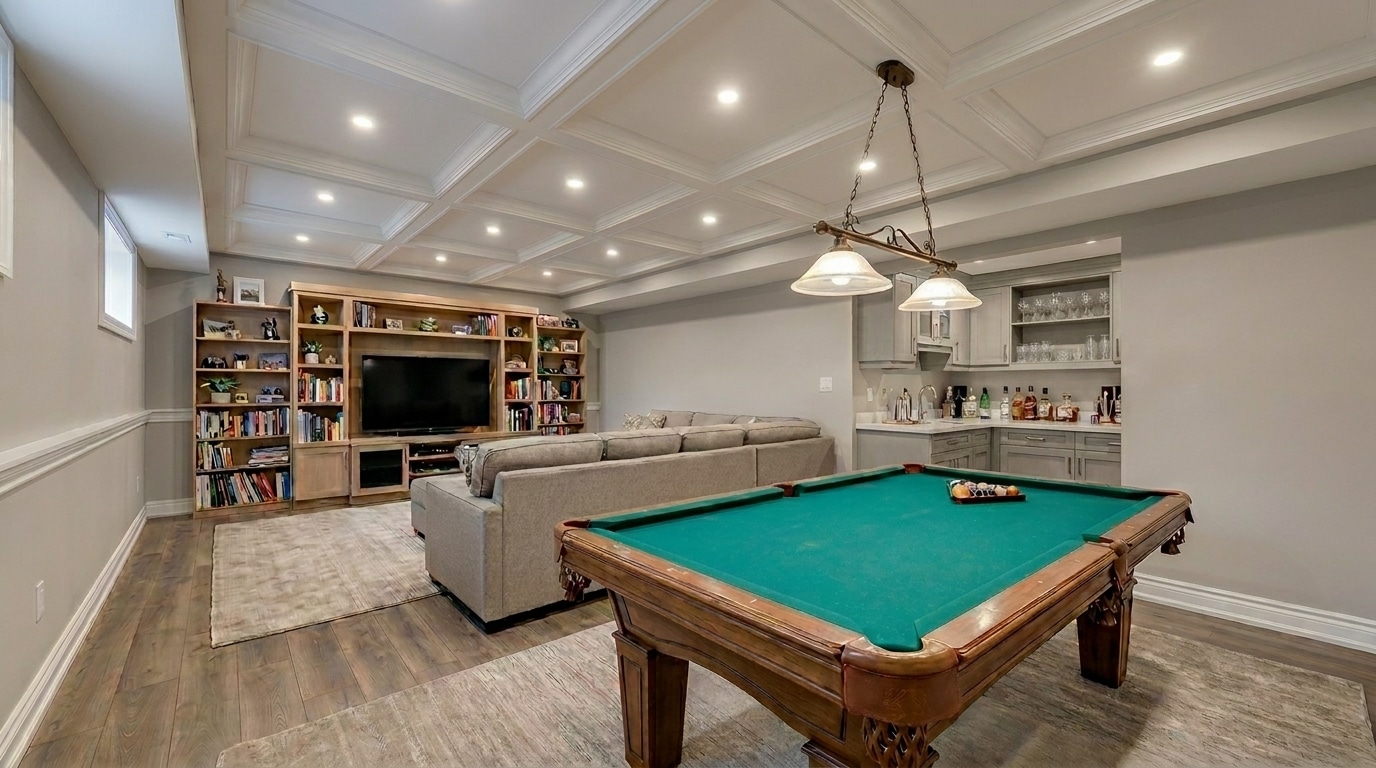
Many basement projects are sold to owners through images of open, bright, main-floor-like rooms. Those images can be useful for inspiration, but they can also distort the starting point. Basement ceiling quality is often dictated first by structure, slab elevation, beams, ducts, plumbing, and the routing needed to serve the rest of the house. By the time those realities are accounted for, the room may still work very well – but not always in the exact proportion, openness, or alignment first imagined.
This is where expectation management becomes especially important. Some lower levels offer enough depth to absorb upgraded assemblies and coordinated services with relatively limited compromise. Others do not. In those cases, every decision competes for the same inches: framing depth, sound control, fire separation, duct runs, drainage slopes, bulkheads, lighting, and transition points under beams. Ceiling height is therefore not a decorative issue. It is a coordination issue.
Owners sometimes ask whether one fix can solve the problem, such as rerouting ducts, lowering a small area selectively, or opening structure in one zone. Sometimes targeted solutions help. Sometimes they simply move the conflict elsewhere. A credible plan has to understand the lower level as a connected system, not as a series of isolated obstacles that can all be solved independently without affecting each other.
That is why basement design benefits from early technical modelling rather than optimistic room naming. The earlier structure and services are coordinated honestly, the easier it becomes to define where height can be protected, where bulkheads are unavoidable, and which layout moves preserve comfort rather than creating a finished space that always feels slightly forced.
Comfort and air quality depend on more than adding supply grilles
A finished basement is expected to be comfortable, but comfort below grade is not created by finishes alone. It depends on how the level is heated, cooled, ventilated, air-sealed, and separated from adjacent service zones. A room that looks refined but feels cold at the floor, stale in the air, noisy beside equipment, or uneven in summer and winter will not perform like a successful living space, even if the millwork and lighting are excellent.
This is one reason mechanical planning has to be tied directly to basement feasibility. Existing systems may not distribute air well to newly enclosed rooms. Equipment locations may conflict with layout goals. Ventilation strategy may need adjustment if the intended use becomes more intensive or more compartmentalised. In some projects, these are manageable coordination issues. In others, they materially reshape the plan and budget direction.
The same applies to acoustic expectations. Basements are often asked to do multiple jobs at once: family room, office, guest area, exercise space, storage, and utility zone. Those uses place very different demands on noise separation, door placement, and mechanical routing. A disciplined plan recognises that comfort is the product of coordinated assemblies and services, not a finishing layer added at the end.
Realistic outcomes come from matching the design ambition to what the house can support
One of the most valuable things a professional process can do on a basement renovation is define the honest ceiling for the project before money is committed to the wrong concept. Some basements can support a highly complete lower-level program with strong comfort and usability. Others are better suited to a more selective outcome: fewer enclosed rooms, a different mix of uses, simpler finish strategy, or a phased approach that resolves core risks before expanding ambition.
This is not pessimism. It is how durable projects are protected. When owners receive an unrealistic early vision, they usually pay for it later in one of three ways: the budget climbs to rescue the concept, the design retreats after time has already been spent, or the final space gets finished to a visual standard that conceals compromises it never truly solved. None of those outcomes is efficient.
Realistic planning also protects prioritisation. If moisture control, egress, headroom, and servicing pressures are already consuming the available budget or spatial flexibility, the design should say so. That allows owners to make informed trade-offs instead of being carried into the pricing stage by assumptions that were never technically stable. In practical terms, that is how a basement project stays disciplined instead of becoming a sequence of reactive decisions.
A disciplined pre-construction process reduces surprises before the basement disappears behind finishes
Basement renovations reward early coordination because so much of the important work becomes concealed. Once framing, insulation, drywall, ceilings, flooring, and cabinetry go in, the opportunity to correct deeper decisions becomes narrower and more expensive. That makes lower levels particularly dependent on serious pre-construction, not just on-site problem solving after demolition has already started.
A strong process tests feasibility, aligns intended use with real constraints, and coordinates structure, moisture strategy, access, mechanical routing, and finish expectations before the plan hardens. It also helps owners understand where the basement can perform exceptionally well, where compromises are unavoidable, and where a phased or narrower scope may produce a better long-term result than an overextended first attempt.
At OakWood, the value of this approach is not that it eliminates every discovery in an older home. It is that it reduces preventable surprise by forcing the real basement questions into the open early enough to matter. That is how moisture risk, egress, ceiling height, and comfort outcomes become planning inputs rather than late-stage frustrations.
The practical takeaway is simple. Basement renovations succeed when the house is read honestly before it is dressed up. When the lower level is planned from the standpoint of actual conditions and intended use, the result is far more likely to be durable, comfortable, and worth the investment.
Visit www.oakwood.ca to explore OakWood’s benchmark design-build process
Email info@oakwood.ca for a professional, no-obligation discussion
Call 613-236-8001 to speak directly with an OakWood expert