

Ottawa projects tend to go sideways for reasons that have nothing to do with finishes. Local approvals, servicing limits, site water, winter logistics, and the realities of older housing stock can all reshape scope once you start asking the right questions.
If you want predictable outcomes, the goal is not to pretend Ottawa is uniform. The goal is to surface the local variables early enough that they are designed around, priced honestly, and scheduled with contingencies that make sense.
At OakWood Designers and Builders Inc., an Ottawa-based design-build firm trusted since 1956, we see the same pattern: the best-run projects are the ones that treat local conditions as inputs to feasibility, not surprises discovered after demolition or after the permit clock has started.
What “local conditions” really means in Ottawa
When people say “Ottawa is a tough place to build,” they are usually describing one of two things: constraints, or variability.
Constraints are the rules and physical limits that you cannot negotiate away. Think municipal approvals, setbacks, servicing corridors, tree protection, heritage requirements, and the way existing utilities enter the building.
Variability is the neighbourhood-to-neighbourhood and lot-to-lot reality. Two homes can be the same age and look identical from the street, but behave completely differently once you open walls, expose foundations, and confirm existing electrical and plumbing capacity.
A disciplined approach treats both as a checklist. Local conditions are not a reason to lower expectations. They are the reason you set expectations using verified information, not assumptions.
Site conditions: soil, water, grades, and trees
If a project is going to surprise you, it often starts with the ground.
Site water management is a common driver. How water moves across the lot, where it is allowed to go, and how the existing foundation has handled it over decades all influence design decisions. It can change where you place additions, how you detail backfill and grading, and what you need to consider around drainage and sump strategies.
Soil conditions and frost behaviour matter because they influence foundations and exterior flatwork. Even without “bad” soil, variability in bearing conditions, existing footings, and past repairs can show up quickly once you investigate. A better framing is to separate what you know from what you still need to verify, then let the foundation strategy follow the evidence.
Grades and access are practical, not academic. A tight lot, limited staging area, or a driveway that cannot support repeated deliveries changes sequencing. It can also affect how you protect landscaping and manage soil stockpiles.
Trees are a quiet constraint. Mature trees can drive where you can build, how you access the site, and how you plan excavation. If the project needs approvals, trees can become part of what reviewers focus on. The right move is not to treat trees as an afterthought, but to factor them into feasibility and early layout choices.
Existing building stock: what older Ottawa homes tend to hide
Ottawa has a lot of homes that have been renovated in waves. That history is often the real “local condition.”
Older homes can contain multiple generations of work. Some is excellent. Some is improvised. Until you verify what is actually in the walls and floors, you are guessing about what can be kept.
Three common categories drive rework:
- Water management and envelope continuity. Small roof, flashing, or air leakage issues that have been tolerated for years become obvious once you change interior finishes or add insulation.
- Electrical and plumbing capacity. Even when things “work,” the existing system may not support modern layouts, additional loads, or new fixture groups without upgrades.
- Structural logic. Previous openings, patched beams, altered joists, or old additions can create discontinuities that need engineering attention once you alter the plan.
The trap is treating these as “construction problems” instead of “decision problems.” Layout choices, window changes, and mechanical plans all depend on what the building can support. This is why feasibility is not just about design taste. It is about confirming what you are building on, what you are tying into, and what the building can realistically support without hidden compromises.
Approvals and neighbourhood constraints: what changes your plan
Ottawa projects are shaped as much by approvals as by design.
Some scopes are straightforward. Others trigger an approvals path that can change timelines and even alter what is worth doing. The practical point is simple: if you assume you can build what you want and “figure out approvals later,” you are creating risk for yourself.
Neighbourhood context matters. Setbacks, height, lot coverage, parking, and exterior changes can all be sensitive depending on the street and the existing pattern of development. Even when something is theoretically permitted, reviewers may look closely at how it impacts neighbours, drainage, or streetscape.
Heritage considerations, if they apply, can influence materials, window proportions, and sequencing. They can also affect what documentation is required and how early you need to align on exterior decisions.
A benchmark-level approach is to treat approvals as a design input. You do not wait until drawings are almost complete to discover that a variance, a different massing strategy, or a revised servicing plan is required. You surface the constraints early, then design within them.
Utilities and servicing: power, sewer, and the invisible constraints
Servicing limits are often invisible until you confirm them.
Electrical service size, panel capacity, and feeder routing can affect what is practical for electrical upgrades and kitchen loads. If a renovation adds major loads or reconfigures spaces, you may need to plan for upgrades and coordinate sequencing around inspections and utility involvement.
Plumbing is similar. The location of stacks, the condition of existing drains, and the slope available under floors can dictate layout. A plan that looks efficient on paper can become expensive if it forces long horizontal runs, conflicts with structure, or requires extensive rework to meet practical installation realities.
Easements, buried utilities, and servicing corridors can constrain where you can excavate or place an addition. On some lots, the most “obvious” addition location is also the most constrained once you verify what is below grade.
The key is to confirm constraints early. When servicing realities are clear, design becomes more honest and pricing becomes less volatile. When they are not, the project often pays for the same decision twice: once on paper, and again in rework.
Seasonality and logistics: winter, access, and sequencing
Ottawa’s seasonality affects construction in ways that are predictable, but only if you plan for them.
Winter conditions can compress exterior work windows and complicate excavation, concrete, and water management. That does not mean you cannot build through winter. It means you need a sequencing plan that protects critical paths and avoids exposing the building to weather at the wrong time.
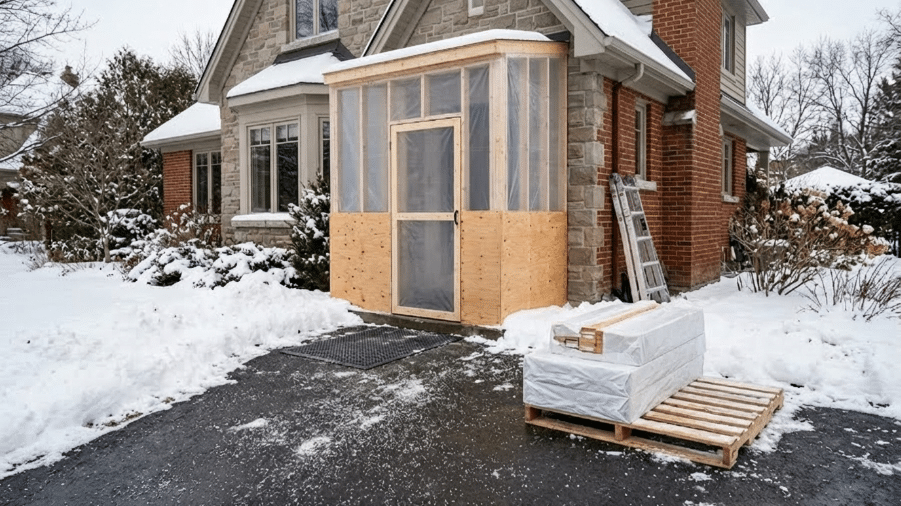
Logistics also matter. Snow storage, temporary access, and safe material handling become operational constraints, especially on tighter urban lots. If deliveries cannot stage, crews spend time moving materials instead of installing them. That is a cost driver that rarely appears in early budgets unless someone has planned for it.
Lead times do not care about season. If cabinetry, windows, or mechanical equipment have longer procurement timelines, you need decisions and approvals aligned early enough that the schedule is not waiting on selections.
This is where process discipline shows up. When decisions are timed properly, winter becomes a planning problem, not a crisis.
Urban infill vs rural lots: different risk profiles
Ottawa is not one condition. Urban infill and rural lots can have very different failure modes.
In urban neighbourhoods, the risk is often constraint density: tighter lots, closer neighbours, limited access, more sensitivity to exterior changes, and more interaction with existing infrastructure. Small layout shifts can create bigger impacts because you are working within a fixed envelope of what is practical on the site.
On rural or larger suburban lots, the constraint density can drop, but the servicing and logistics questions can become more dominant. Access, temporary power, drainage strategy, and long delivery paths can influence sequencing and cost. The project may also depend more heavily on confirming what is actually in the ground and how the site handles water season to season.
In both cases, the common thread is the same. The earlier you validate constraints, the less you rely on hope. And hope is an expensive substitute for verification.
A feasibility self-check before you commit
If you are early in the process, these decision gates will tell you whether your project is ready to move forward, or whether you need more validation first:
- Do you have a clear scope statement that separates “must-haves” from “nice-to-haves,” and is it consistent with what the house and site can support?
- Have you verified the existing conditions that drive big costs, such as water management issues, structural discontinuities, and electrical and plumbing capacity?
- Do you know whether the scope is likely to trigger permits, variances, or heritage review, and have you allowed time for that in your plan?
- Have you confirmed the servicing constraints that affect layout, including stack locations, under-floor routing limits, and exterior utility corridors?
- Is your schedule built around decision timing and long-lead items, not just construction duration?
- Do you have a plan for site logistics, including access, protection, and staging, that matches your lot and season?
How we build certainty without pretending Ottawa is predictable
The consistent way to reduce surprises is to separate assumptions from verified inputs, then lock decisions in the right order.
Under The OakWood Design-Build Process®, feasibility work is used to validate constraints before design decisions become expensive to reverse. It is where we confirm what approvals may be needed, what the existing building is likely to require once opened, and what site conditions will drive the build strategy.
This is also where conservative language matters. No professional can guarantee what is inside a wall until investigation happens, and no one can promise approvals that depend on third-party review. What you can do is build a plan that expects uncertainty in the right places and removes it where verification is possible.
The goal is not to chase perfection. The goal is to make decisions on the best available information, document them, and manage change fairly when reality proves different.
What to do next
If you are planning a renovation, addition, or custom build in Ottawa, treat local conditions as the first design brief.
Start with the questions that change everything: site water, servicing constraints, approvals triggers, existing conditions, and logistics. When those are understood early, the rest of the project becomes a sequence of decisions rather than a sequence of surprises.
If you want a benchmark-level approach that is grounded in verified inputs and disciplined decision timing, OakWood can help you frame feasibility and scope in a way that supports honest pricing and a workable schedule.
Navigation
Permit pathway in Ottawa: what drives review timelines and resubmissions
Renovation permits in Ottawa: when you need them and what changes the timeline
Site servicing constraints: grading, drainage, and access issues that change feasibility
Heritage constraints in Ottawa: how they affect scope, approvals, and sequencing
Older Ottawa homes: why feasibility and approvals matter more than expected
— CTA —
Visit www.oakwood.ca to explore OakWood’s benchmark design-build process
Email info@oakwood.ca for a professional, no-obligation discussion
Call 613-236-8001 to speak directly with an OakWood expert