

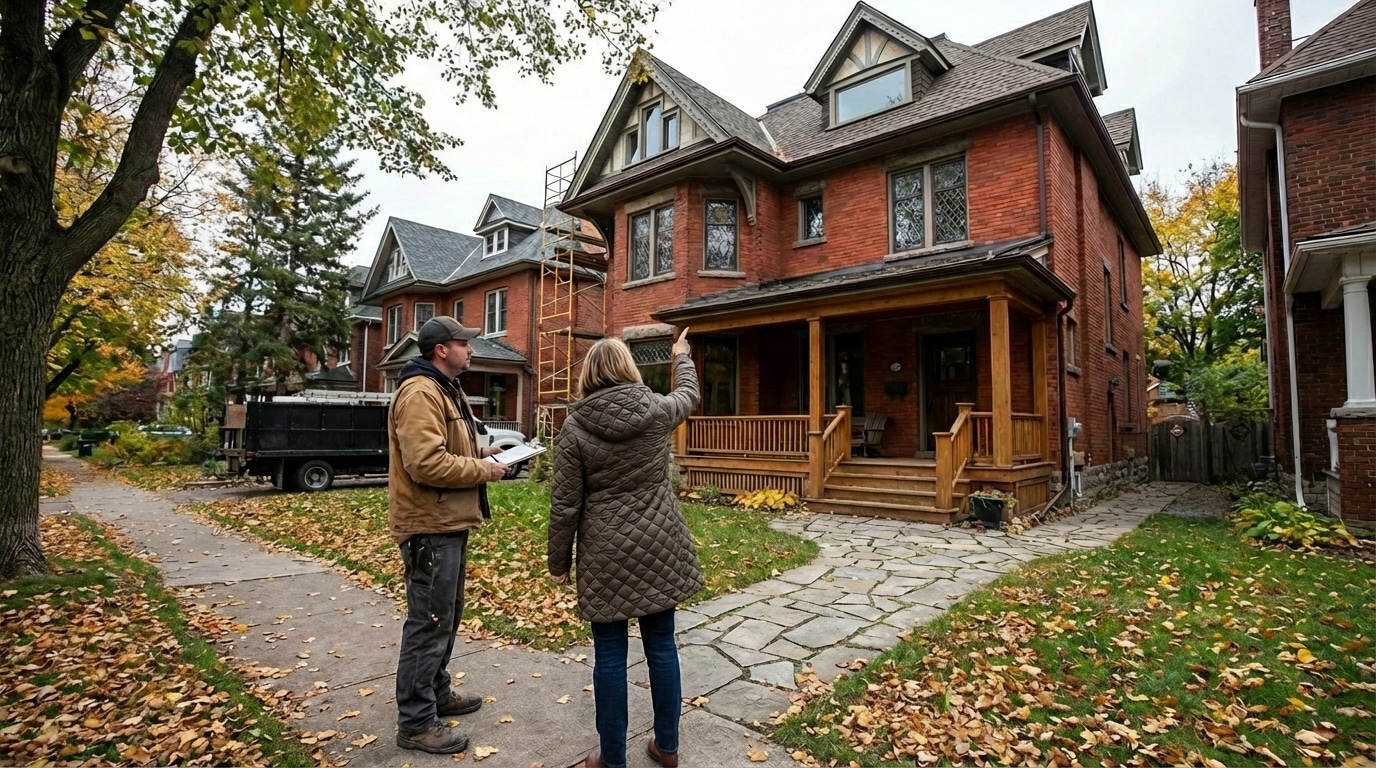
Heritage constraints are often misunderstood as a design-style issue. In practice, they are a project-governance issue. They can reshape what is realistic to build, what has to be retained or justified, which approvals are needed, and when key decisions have to be made if the project is going to move forward in a controlled way.
In Ottawa, that matters because “heritage” is not one condition with one approval path. A property may be individually designated, located in a heritage conservation district, listed on the Heritage Register without being designated, or located in a cultural heritage character area. Those categories do not carry the same consequences. Some scopes require a heritage permit under the Ontario Heritage Act. Some trigger demolition notice requirements. Some involve no heritage permit at all, but still influence how a proposal will be judged in context.
The real decision is not whether a team can draw a beautiful concept first and solve heritage later. The real decision is whether the concept is being developed inside the actual approval and sequencing constraints of the site. When that is not tested early, owners often discover too late that the preferred massing, demolition assumption, addition strategy, or material approach does not survive review without redesign.
At OakWood, we treat heritage risk the same way we treat other serious pre-construction risk: it has to be surfaced early enough to control scope, approvals, and sequencing before the project starts accumulating false confidence. That is consistent with a benchmark design-build approach, because disciplined projects do not wait until submission to discover that the site was carrying a different burden than the concept assumed.
Heritage status is not one thing
One of the fastest ways to lose control of a heritage project is to use one label for several different legal and planning conditions. In Ottawa, an individually designated property is not the same as a property in a heritage conservation district. A listed but non-designated property on the Heritage Register is not the same as either of those. A cultural heritage character area is different again. Each category affects scope and timing differently.
That matters immediately because the approval burden changes with the status. Ottawa’s heritage-permit guidance states that a permit under the Ontario Heritage Act is required when the scope includes demolition, new construction in a heritage conservation district, or alterations to a designated property that affect heritage attributes. By contrast, Ottawa’s own guidance for cultural heritage character areas says they are not designated under the Act and do not require heritage permits. If a team fails to identify that distinction at the start, it may either underestimate the approval path or waste time solving the wrong problem.
Owners also need to be careful with listed properties. Listing on the Heritage Register does not mean full designation, but it still matters. Ottawa’s register guidance and related City material make clear that listed, non-designated properties trigger notice requirements when demolition is proposed. That means a site that looked simple from a demolition standpoint may still carry timing consequences before redevelopment can move ahead.
Scope changes because heritage is part of the brief
Once heritage protection applies, the project is no longer being judged only as a private design problem. It is also being judged against the character the municipality is trying to conserve. That changes the practical brief. The team is not simply asking what fits the lifestyle program or the square footage target. It is also asking what can be altered, what should be retained, how an addition should read beside the existing building, and whether new work will be seen as compatible with the property or district rather than disruptive to it.
This is why heritage projects often change scope before they change drawings. A seemingly straightforward rear addition can become more complex if the relationship to a roof form, a side elevation, a visible setback condition, a porch, a window pattern, or another character-defining element is not as flexible as the owner assumed. Likewise, a replacement strategy can become much harder if the project begins with the idea that demolition is the cleanest path but the site sits in a context where demolition or removal carries a much higher approval burden.
Serious teams therefore stop treating retained elements as decorative leftovers. They treat them as governing conditions. Existing walls, volumes, openings, materials, and street-facing relationships can all affect what a viable proposal looks like. The important point is not to romanticise those constraints. It is to recognise them early enough that the scope is built around reality instead of around a concept that must later be defended, reduced, or abandoned.
Heritage approval does not replace the rest of the approval path
A common client mistake is to assume that once the heritage question is identified, the project has found its main gate. In reality, heritage approval is often only one layer. The project may still need a building permit, may still need zoning relief, may still require technical drawings, and may still trigger supporting material if grading, servicing, access, or right-of-way issues are involved. Heritage review does not erase those other obligations.
Ottawa’s heritage material points in that direction in two ways. First, the City’s heritage process is its own approval stream under the Ontario Heritage Act. Second, Ottawa’s broader heritage and zoning guidance notes that heritage areas can also be affected by the Heritage Overlay, which introduces its own development constraints for additions and new construction. In other words, a proposal may satisfy one question and still have unresolved work to do on another.
That is one reason heritage projects drift so easily when they are managed in fragments. One consultant may be thinking about form and compatibility, another about code and permit drawings, another about site conditions, while the owner is looking at a target start date. If no one is controlling the whole stack, the project can appear to be progressing while its approvals remain misaligned. OakWood treats this as a coordination issue, not merely a heritage issue, because the same gap later shows up in pricing, sequencing, and change control.
Sequencing is where many heritage projects lose time
Heritage constraints do not only affect what gets approved. They affect when decisions must be made. A concept that might be tolerable in an ordinary file can be too unresolved in a heritage file because the approval discussion depends on a clearer explanation of what is being kept, what is changing, why it is changing, and how the new work relates to the protected context.
Ottawa’s heritage process also makes sequencing more visible than many owners expect. Depending on the application, the file may move through heritage staff review, the Built Heritage Committee, Planning Committee or Agriculture and Rural Affairs Committee, and City Council. The City also has guidance for Cultural Heritage Impact Statements in cases where the project needs a more formal heritage rationale. None of that should be read as a reason to panic. It should be read as a reason to stop pretending that heritage review can always be bolted on after the main design decisions feel complete.
The statutory timeline can also mislead people. Under the Ontario Heritage Act, a permit application is subject to a 90-day decision period once the required notice of receipt has been given. That sounds orderly, but it does not rescue a weak application. The real schedule risk is usually the time spent before that point, when the team is still trying to determine the right scope, the required supporting material, and whether the concept can survive review without major redesign.
Demolition and replacement assumptions are where projects often go wrong
Some of the most expensive heritage mistakes begin with a hidden assumption that the existing building, or a large part of it, can simply be removed if retention proves inconvenient. In Ottawa, that is not a safe starting point on a heritage-affected property. The City’s heritage-permit guidance explicitly identifies demolition and new construction as scopes that can require approval under the Ontario Heritage Act. That means demolition is not merely a site-preparation decision. It is part of the heritage case itself.
The same caution applies to listed properties. A team may tell itself that the building is not designated, so demolition is straightforward. But if the property is listed on the Heritage Register, the demolition notice requirement still affects timing and risk. A project that was budgeted and sequenced as though demolition were immediate can therefore lose stability before the new design has even been fully documented.
This is one reason disciplined heritage planning starts with a blunt feasibility question: what must be preserved, what might be alterable, and what assumptions about removal are too aggressive for the site? That is a better early conversation than spending weeks refining a replacement concept that was never likely to pass the first approval gate.
What serious teams resolve before the heritage design advances too far
A strong heritage file does not begin with an elaborate defence of a preferred concept. It begins with a controlled understanding of the site. The team confirms the exact heritage status, the by-law or district context, the visible attributes or character issues likely to matter, the review path, and the other approvals that will travel with the project. Only then does the concept work start to mean something.
That early work usually changes three things. First, it changes massing discipline. The team understands sooner whether the project should be framed as a modest alteration, a more visible addition, a contextual infill condition, or a higher-risk intervention. Second, it changes documentation discipline. The team knows whether the file may need heritage-focused drawings, streetscape logic, material reasoning, or a Cultural Heritage Impact Statement rather than only standard permit sheets. Third, it changes sequencing discipline. Owners can make decisions with a clearer sense of what has to be approved before procurement, consultant work, or permit submission pushes too far ahead.
At OakWood, that is where the value of The OakWood Design-Build Process® becomes practical. Heritage files rarely fail because people lacked enthusiasm. They fail because the concept, the approvals path, and the execution sequence were not aligned early enough. A disciplined process makes those alignments visible before the project starts spending money against an unstable assumption set.
Five early checks before heritage work advances
- Confirm the exact heritage condition of the property first: designated, district, listed, or character area. Do not design from a vague understanding of “heritage.”
- Test whether the preferred scope depends on demolition, removal, or highly visible change before the concept hardens around it.
- Identify the full approvals stack early, including building permit, zoning, site, and heritage requirements, instead of treating heritage as the only gate.
- Decide whether the file may need heritage-specific support material, such as a Cultural Heritage Impact Statement or stronger contextual documentation.
- Build the schedule around approval logic, not optimism. Heritage files become unstable when design momentum outruns the real review path.
Why this is a governance issue, not a styling debate
Heritage constraints in Ottawa are manageable when they are treated honestly. They become expensive when they are minimised, oversimplified, or left until the project already has emotional and financial momentum behind a preferred answer. The mistake is rarely that the City had heritage rules. The mistake is that the project behaved as though those rules were secondary until they became unavoidable.
That is why disciplined firms do not reduce heritage to taste. They treat it as governance. What is protected, what needs approval, what can be justified, what other approvals interact with the file, and when each decision has to be made are all practical management questions. OakWood approaches heritage work this way because clients do not benefit from a beautiful concept that cannot move through the real approval path on a controlled schedule.
Visit www.oakwood.ca to explore OakWood’s benchmark design-build process
Email info@oakwood.ca for a professional, no-obligation discussion
Call 613-236-8001 to speak directly with an OakWood expert