
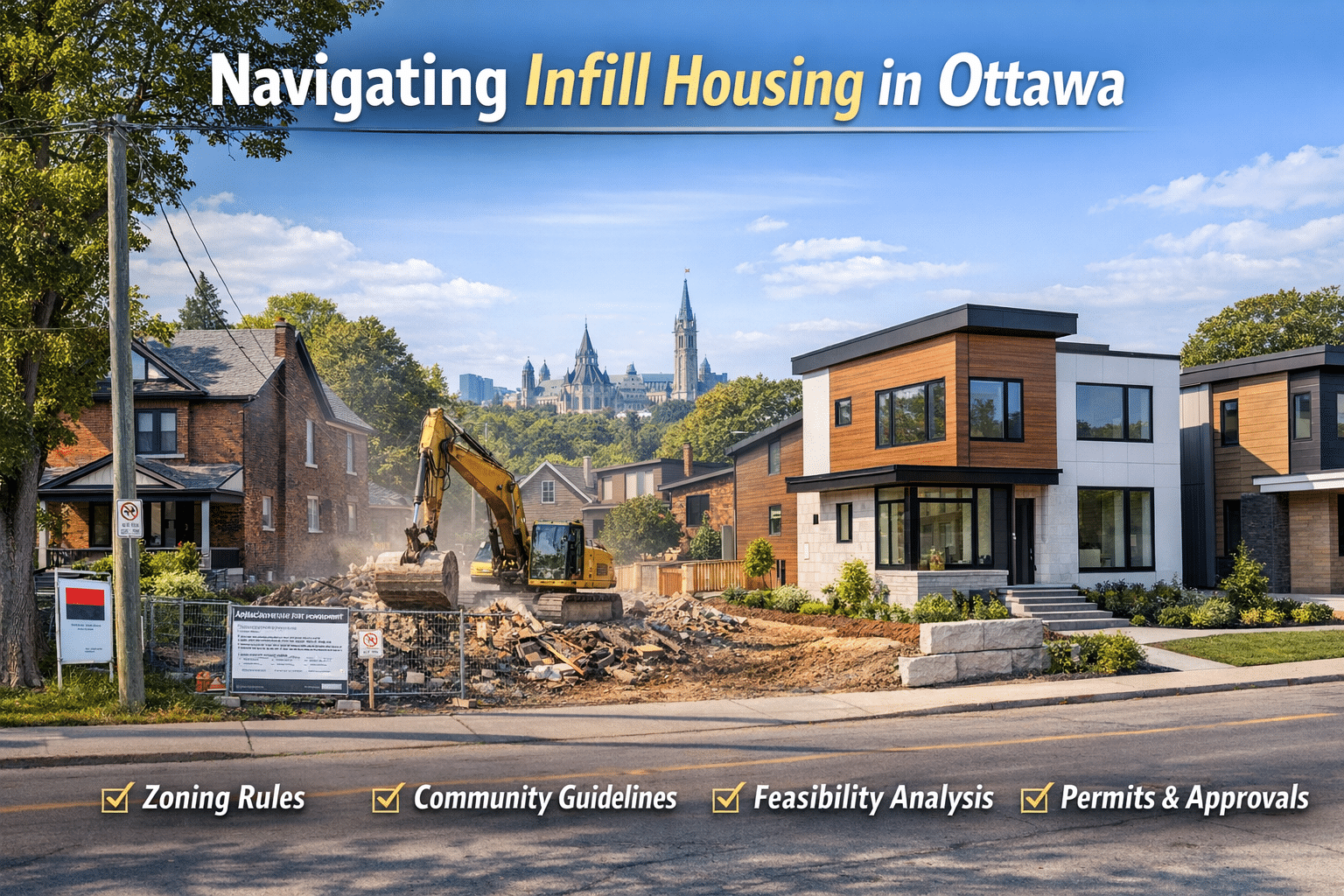
Infill housing in Westboro Hintonburg Glebe has become one of the most complex and closely regulated forms of residential construction in Ottawa, shaped by zoning rules, neighbourhood context, and evolving urban design standards.
Ottawa’s mature neighbourhoods are evolving. As land becomes scarcer and homeowners look to maximize the value of well-located properties, infill housing has become one of the most sought-after, and most regulated, forms of residential construction in the city.
If you’re planning an infill project in Westboro, Hintonburg, The Glebe, or Old Ottawa South, understanding what you can and can’t build is critical before committing to design, or even purchasing a property.
This guide explains how infill housing works in Ottawa, the zoning and design rules that shape these projects, and why early feasibility analysis is essential when working with an experienced Ottawa infill builder.
What Is Infill Housing in Ottawa?
Infill housing refers to new residential construction on existing serviced lots within established neighbourhoods. In practice, infill projects typically involve:
- Demolishing an existing building(s) and building new
- Replacing a smaller/older home with a more efficient home with a larger footprint or second storey
- Where zoning permits, Creating a multi-unit building or secondary dwelling
- Severing a wider lot into two narrower parcels, and building two free-standing or attached homes
Unlike suburban developments, infill projects must fit within long-established streetscapes, next to homes built decades earlier under very different zoning standards. That context-sensitive requirement is what makes infill both valuable, and complex.
Why Infill Projects Are More Regulated Than New Subdivisions
Infill construction is governed not just by zoning by-laws, but also by:
- Neighbourhood character policies (Maintains a communities built form and style)
- Urban design guidelines (Creates a framework for paths, travel and Access to amenities)
- Mature Tree and Green space Guidelines (Keeps established community vegetations in-tact)
- City Committee of Adjustments and Community Associations (Increased public and municipal scrutiny, working together to help a community develop)
In neighbourhoods like Westboro, Hintonburg, and The Glebe, even projects that technically comply with zoning can face resistance if they are perceived as out of scale or incompatible. Working with these organizations and committees early in the process can help to guide home design and create a unique home which fits with the neighbuorhood aesthetic and built-form
This is why infill success often depends on early feasibility review, not just architectural creativity.
Key Zoning Rules That Shape Ottawa Infill Homes
1. Lot Width, Setbacks, and Buildable Envelope
Most established neighbourhoods often have narrower lots, which significantly affects what can be built.
Zoning controls typically regulate:
- Minimum front, rear, and side-yard setbacks (buildable lot area)
- Maximum Building Height
- Minimum separating distance between buildings
- Allowable Glazing (windows) facing neighbors
- Maximum number of Dwelling units
Front, Side and Rear-yard Setbacks are one of the most common infill challenges. A few inches can determine whether a design is permitted as-of-right or requires a zoning variance.
2. Building Height andStoreys
Ottawa zoning limits height using several metrics:
- Maximum building height (measured in metres)
- Maximum number of storeys
- Relationship to adjacent homes
Each Neighbourhood is different, while many areas permit up to 2.5 or 3 storeys, the number of stories can vary based on the height of each storey and the home design. Building height is often measured to the midpoint of the roof—not simply floor count. Flat roofs, modern massing, and third-storey layouts require careful planning to remain compliant.
3. Angular Planes and Massing Controls
Certain neighbourhoods include angular plane regulations, which limit how close upper floors can be to property lines and overhead services. These controls are intended to:
- Reduce shadowing
- Protect privacy
- Maintain neighbourhood scale
- Create a safe community.
They frequently affect:
- Rear additions
- Third-storey bedrooms
- Contemporary flat-roof designs
Angular planes are especially relevant in The Glebe and Old Ottawa South.
4. Lot Coverage and Floor Space Index
Zoning also restricts:
- Maximum lot coverage (how much of the lot can be built on)
- Total floor area relative to lot size
These limits often surprise homeowners and can force design reductions late in the process if not addressed early.
When Is a Zoning Variance Required?
A minor variance may be required when a project does not fully comply with zoning provisions. Common triggers include:
- Reduced side-yard setbacks
- Slight increases in height or building width
- Increased lot coverage or floor area
Approval is not automatic. The Committee of Adjustment evaluates whether a variance is:
- Minor in nature
- Appropriate for the neighbourhood
- Consistent with the intent of the zoning by-law
Projects with strong design rationale and professional planning support are far more likely to succeed.
Infill Housing in Westboro, Hintonburg, and The Glebe: How the Rules Differ by Neighbourhood
Westboro & Hintonburg
- Narrow urban lots
- Strong emphasis on streetscape rhythm
- Contemporary infill is common, but massing matters
Designs that respect front-yard setbacks and neighbouring rooflines are more often supported. Each home is evaluated on a case-by-case basis.
The Glebe & Old Ottawa South
- Heritage conservation districts and overlays
- More detailed design review
- Greater emphasis on materials, proportions, and contextual fit
- Garages and Driveways are less common and must follow the streetscape
In these areas, compliance alone is often not enough—design quality plays a decisive role. Community involvement and support of local Associations play a key role in the success of a project
Permits and Approvals: What the Process Typically Involves
Most Ottawa infill projects require:
- Site plans, including Grading and Servicing Plans
- Full architectural Drawings
- Engineering review and structural drawings
- City Zoning and Streetscape review
- Committee of Adjustment approval (if variances apply)
- Building Permit Review and issuance
Unlike suburban builds, these steps are rarely linear. Revisions are common, and timelines vary depending on complexity and neighbourhood context.
This is why a design-build approach is particularly valuable for infill projects—it keeps zoning, design, and construction aligned from the start.
The Importance of Early Feasibility Analysis
One of the most common infill mistakes is designing before understanding the site’s true constraints.
Early feasibility analysis typically includes:
- Zoning and Streetscape review
- Preliminary discussions around variance risk
- Early discussions with Community Partners
- Lot Surveys and Topography Review
- Mature Tree Review and Planning
- Setback and massing analysis
At OakWood, this step is foundational to all OakWood infill homes, helping clients make informed decisions before significant design costs are incurred.
Why Experience Matters When Choosing an Ottawa Infill Builder
Infill construction requires more than technical building skills. It demands:
- Deep zoning knowledge
- Realistic assessment of known challenges and approval risk
- Neighbourhood-specific experience
- Strong relationships with consultants and inspectors
- Existing relationships with community Associations
- Respected and eliable reputation
OakWood brings decades of experience navigating Ottawa’s most complex neighbourhoods, delivering infill homes that balance modern living with community context.
Thinking About an Infill Project in Ottawa?
Before committing to a design, or purchasing a property for redevelopment, it’s essential to understand what the site can realistically support.
A feasibility-first approach helps protect your investment, reduces approval risk, and sets the foundation for a successful infill project from day one.
OakWood specializes in informed, design-led infill housing across Ottawa’s established communities, guiding homeowners from feasibility through construction with clarity and confidence.